
The Gameplay Trailer Is Out Now
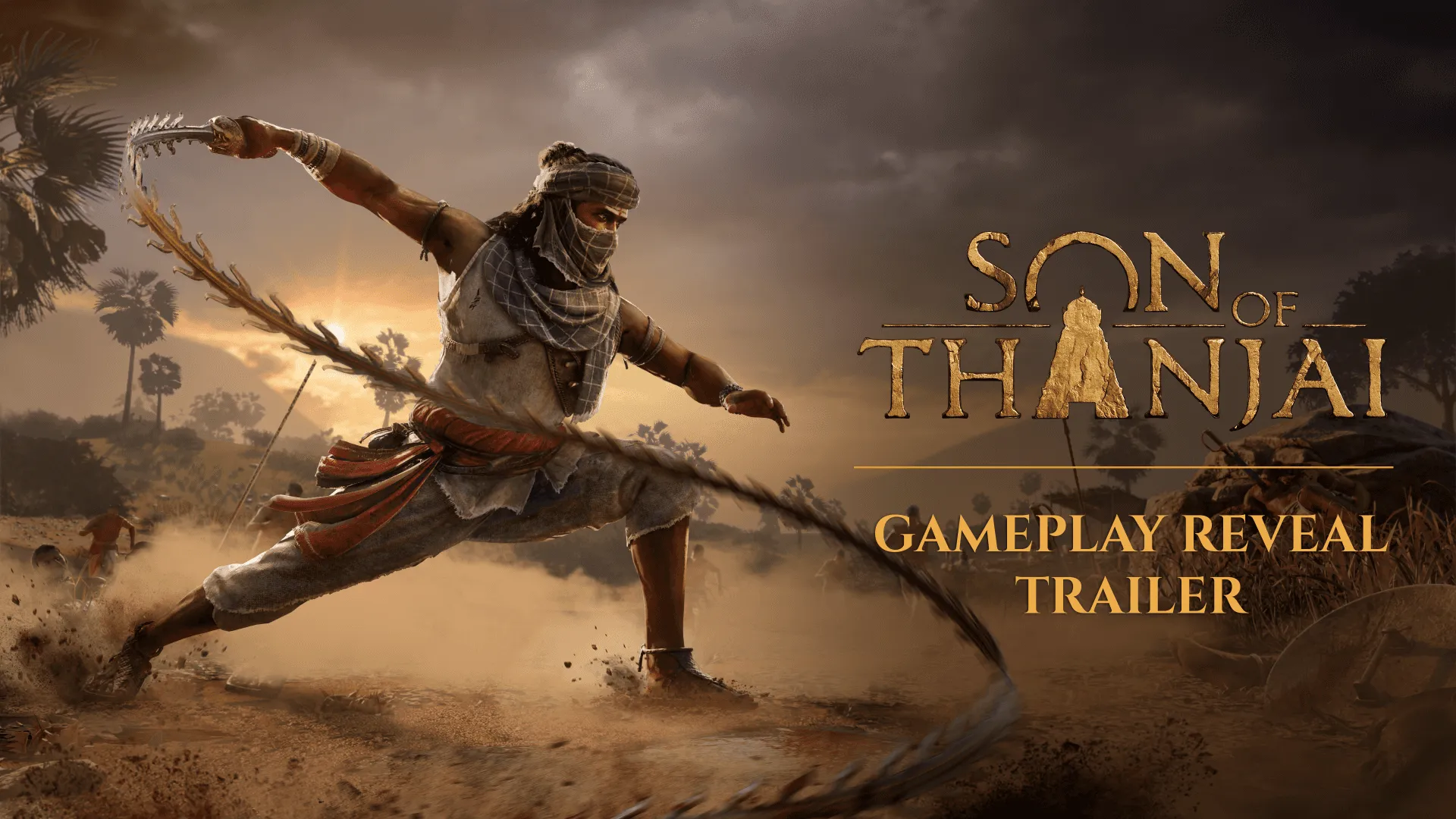
Nine months after the Future Games Show teaser, the first real gameplay trailer for Son of Thanjai is here. Meet Vinnendhira Chola, the Surul Vaal combat system, and the living world of 11th-century Thanjai.
Nine months of silence. Since the Future Games Show last August, you’ve had a 90-second teaser, a Steam page, and our word that we were building something. No screenshots. No combat reveals. No protagonist’s name. Just the wait. (Not counting that YouTube video, IYKYK.)
Today, the wait is over.
This is your first real look at the protagonist, the combat, the stealth, and the weapon at the center of it all. We picked this sequence on purpose. It carries the three things we’ve been building toward: a living Thanjai that goes on whether you’re in it or not; stealth and deception; and the Surul Vaal combat that delivers on the only promise that matters: you’ll be the most dangerous man in any room you walk into.
The son of Thanjai
His name is Vinnendhiran Chola. King of the skies. If that’s a mouthful, just call him Chola.
Vinnendhira is not a conqueror marching with armies behind him. He moves through darkness. Through crowded streets, hidden paths, collapsing battlefields, and enemy territory where one mistake means death. He survives through instinct, precision, and fear.
In our original plan, the protagonist was Rajendra Chola himself. For the uninitiated, Rajendra was a formidable king who ruled from South India all the way to Indonesia, venerated across a thousand years of Tamil memory as one of the great rulers of the subcontinent.
We made a deliberate choice this year. We wanted to write a prince who could be flawed. Morally gray. Sometimes plain wrong. We did not want to walk on eggshells every time the character messed up — and the historical Rajendra, whose legacy we love and respect, doesn’t deserve to be the man making those mistakes on screen.
So we took a half-step sideways. Son of Thanjai is alternate history. Vinnendhira is the prince Rajendra might have been if the world had broken him a little harder before he became king. He’s spoiled. Broken. Brilliant at things a prince shouldn’t have to be brilliant at: manipulation, deception, and terror. When you pick up the controller, he’s a spoiled prince. By the time you put it down, you’ll have decided what he becomes.
Fear is your weapon
Combat in Son of Thanjai is psychological. Brutal and aggressive. Enemies react to violence. Soldiers panic when allies fall. Confidence breaks. Survivors reconsider whether they want to continue fighting at all.
It’s based off this three-pronged combat loop:
Disrupt: The Surul Vaal. Four to six meters of whip-sword that coils as a belt and snaps out into a 180-degree sweep; covers ground no straight blade can match. It’s designed to break formations and control space. You don’t fight one enemy at a time. You fight the half-circle around you, and each successive combo cuts a wider arc than the last.
Dismember: Limbs come off. Heads come off. Chola isn’t a superhero. He can’t tank thirty hits but the Surul Vaal doesn’t have to hit the same man twice. Every dismemberment drains the morale of every enemy who saw it.
Execute: An enemy with broken morale can be executed in a way that is over the top, by design (wink wink). The execution earns its theatrics: one execution and the back of the mob starts thinking about running. Like that movie you’re thinking of right now.
This is not hack-and-slash. We wanna be explicit about it. Button-smashing won’t work. You cannot fight thirty people through skill alone; if you try, you’ll be surrounded, and a three-enemy attack window will end you. You fight thirty people by making half of them not want to be the next one to die. That’s the system the whole game runs on.
You’re not invisible
Stealth in Son of Thanjai runs on a parallel loop: observe, isolate, exploit.
Every action makes a noise. Walk through grass and the grass moves. Crouching doesn’t make you invisible. Sneak too fast, you’ll be heard. Get too close, you’ll be heard.
Sight works the same way. The peripheral vision in our game runs wider than any stealth game we could find a number for. You can’t slip behind a guard by being two feet to their left. And they watch each other. If one of them notices something, the next one notices the first one noticing. A chain reaction starts in the corner of your eye, and by the time you’ve drawn your blade, all of them are looking your way.
So when you shadow someone, you plan the kill before you start. Where to break off. Where the body falls. Who else can see it.
There is no X-ray vision in this game. No tagging. No glowing breadcrumbs. Every piece of intel must be earned: by watching, by overhearing, by interrogating, by shadowing. It’s a small thing on paper and a big thing in play.
It’s also the cleanest demonstration of the principle behind the entire stealth design: Earn the intel. Earn the kill.
The world is something else
The combat is short and lethal. The stealth is patient and earned. The world is something else again.
11th-century Thanjai isn’t a mere backdrop. It’s a place we want you to be in long after the encounter ends even if you never follow the main story. Markets. Toddy shops. Gambling villages. Conversations you weren’t meant to hear. The sound of the river before dawn. NPCs who live their own lives, not stand around waiting to give you a quest. It’s the kind of slow-burn world that comes alive whether or not you’re doing anything in it. This is where the immersion lives.
The Indian warrior archetype
There’s a longer conversation behind everything in this trailer, and we want to say it once here.
Pirates, cowboys, ninjas — they’re eternally cool. They’ve survived a century of pop culture because the silhouette is iconic. You can drop a cyberpunk ninja or a space cowboy into any decade and the audience already knows what they’re looking at.
India has never had this silhouette. The concept of an Indian ninja, an Indian knight, an Indian warrior does not exist in any global media form. Our heroes are tied to higher ideals: devotion and duty and honor. They’re not the lone, rugged, cunning, morally gray operator that gives the other archetypes their longevity.
Son of Thanjai is our attempt to build that silhouette. An Indian warrior whose differentiator is psychological. Bluffing, luring, manipulating, terrorizing, reading the enemy’s mind and breaking it. Carrying weapons no other game carries because no other game has had reason to: the Surul Vaal, yes, but also the Aruvaal, a farmer’s tool that lets a prince walk through a village without anyone noticing he’s armed, and the Valari, a throwing weapon that takes down multiple enemies at once because the psychological effect of a triple-hit ranged kill is the point of carrying it. You’ll see all three in the trailer. There’s more at your disposal in the game.
What’s next
And this was our first true glimpse into the violence, tension, and identity of the world we are building. There is still more to reveal: the many cities of the Chola empire, exploration, political conflict, culture, and the deeper journey of Vinnendhira himself.
The game is coming to PC (Steam and Epic), XBOX X|S, PS5.
Wishlist Son of Thanjai on your favorite platforms — all the links are here: Wishlist Now.
Share the trailer with your gamer friends. Talk about it online. Every bit helps. The world of Thanjai is waiting.